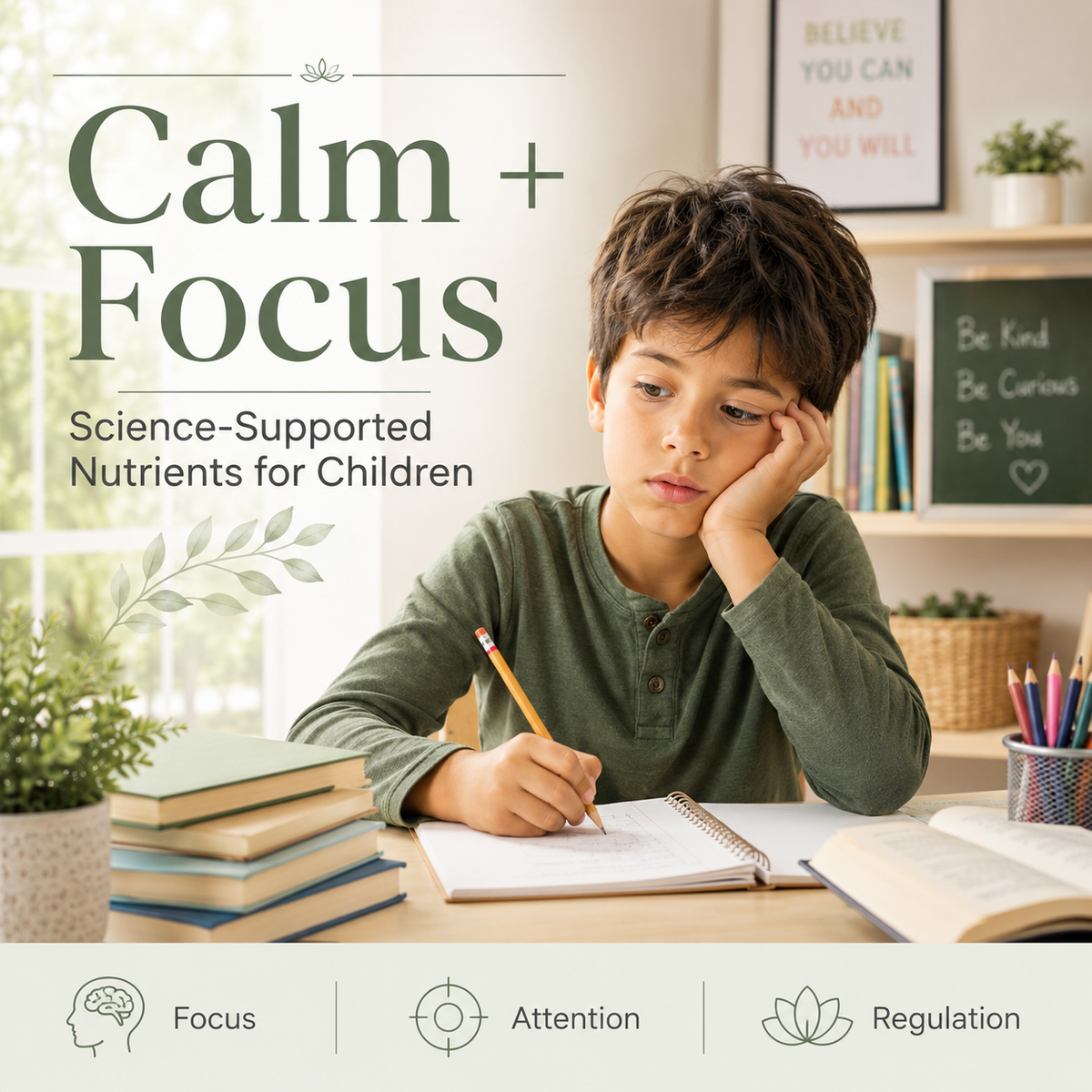
Back-to-School Focus: 4 Nutrients to Support Calm, Attention & Learning in Kids
Approximately 1 in 9 children in the United States has received an ADHD diagnosis.
According to data from the 2022 National Survey of Children’s Health, an estimated 7.1 million U.S. children ages 3–17 have been diagnosed with ADHD at some point, and more than half of children with current ADHD were receiving ADHD medication.
These numbers highlight just how common challenges involving attention, impulsivity, and regulation have become.
But difficulty focusing isn’t limited to children with an ADHD diagnosis.
For many children, returning to school represents a dramatic change in what their nervous system is being asked to do. Kids are naturally driven to move, explore, socialize, play, and seek novelty. A classroom asks them to do something very different: sit relatively still, filter distractions, transition between tasks, and sustain attention for extended periods.
Add today’s environment of constant digital stimulation, short-form content, gaming, and rapidly changing information, and maintaining a calm, focused state can become even more challenging.
From a functional wellness perspective, attention isn’t simply about willpower. Sleep, stress regulation, nutritional status, neurotransmitter activity, and nervous-system balance can all influence a child’s ability to feel settled and ready to learn.
Focus Isn’t Always About More Stimulation
When we think about improving focus, it can be tempting to think only in terms of increasing stimulation.
But effective learning requires something more nuanced: the ability to remain alert while also being regulated.
A child who feels excessively restless, stressed, or overstimulated may have difficulty directing that energy toward the task in front of them. This is why several nutrients and botanical compounds being studied for children’s wellness are particularly interesting—they may help support the balance between relaxation and alertness.
Here are four worth knowing.
1. L-Theanine: Supporting Relaxed Alertness
L-theanine is an amino acid naturally found in tea and has become increasingly interesting in nutritional neuroscience because of its potential role in supporting relaxation without significant sedation.
Rather than simply making someone sleepy, L-theanine has been studied in the context of stress response, sleep, and what could be described as a more relaxed state of alertness.
Pediatric research is particularly noteworthy. In a randomized, double-blind, placebo-controlled trial involving 98 boys ages 8–12 who had been diagnosed with ADHD, L-theanine supplementation resulted in significant improvements in certain objective measures of sleep quality and was well tolerated.
The study evaluated sleep rather than demonstrating that L-theanine treats ADHD. However, the connection is relevant from a functional perspective: healthy sleep and nervous-system regulation are fundamental components of daytime cognitive performance.
2. Saffron: An Emerging Botanical for Attention & Emotional Regulation
Saffron may be best known as a culinary spice, but its bioactive compounds have generated growing interest in research surrounding mood, stress, and neurological function.
One small randomized, double-blind pilot study involving 54 children and adolescents with ADHD compared saffron with methylphenidate over six weeks. Researchers reported no significant difference between the groups in changes measured by the study’s ADHD rating scales.
This was a preliminary study with a small sample size, so it should not be interpreted to mean that saffron is a replacement for ADHD medication. It does, however, make saffron an intriguing botanical for continued research into children’s attention and behavioral health.
From a functional wellness perspective, saffron represents an interesting intersection between traditional botanical medicine and emerging nutritional neuroscience.
3. Lemon Balm: Botanical Support for a More Regulated State
Lemon balm, or Melissa officinalis, has a long history of traditional use as a calming botanical and is increasingly being investigated for its relationship with stress, sleep, and nervous-system regulation.
In one study, 169 primary-school children experiencing hyperactivity and concentration difficulties were given a combination of lemon balm and valerian extracts for seven weeks. Parent and practitioner assessments reported improvements in concentration difficulties, hyperactivity, and impulsiveness.
Importantly, the study used lemon balm together with valerian, meaning the results cannot be attributed to lemon balm alone.
Still, the findings add to the growing interest in calming botanicals as part of a broader strategy for supporting a more balanced and regulated nervous system.
4. Magnesium: Foundational Support for the Nervous System
Unlike the other ingredients on this list, magnesium isn’t primarily a “focus supplement.” It is an essential mineral involved in hundreds of biochemical reactions throughout the body and plays important roles in normal neurological function, energy metabolism, muscle function, and overall nervous-system health.
Magnesium status has also been investigated in children experiencing attention and behavioral challenges.
In one randomized controlled trial involving children with ADHD, researchers studied magnesium together with vitamin D and reported improvements in several measures of behavioral and mental health compared with placebo.
Because magnesium was combined with vitamin D, the study cannot tell us what magnesium would have accomplished independently. Still, it reinforces an important functional wellness principle: before focusing exclusively on symptoms, it is worth considering whether the developing nervous system has the foundational nutrients it requires.
The Goal Isn’t to Make Kids Less Like Kids
Children are supposed to move. They’re supposed to explore, ask questions, become excited, get distracted, and occasionally have more energy than the adults around them know what to do with.
Supporting focus shouldn’t mean suppressing those qualities.
A functional approach asks a different question: How can we support the systems that allow a child to shift into a calmer, more attentive state when the situation calls for it?
Adequate sleep, movement, balanced nutrition, appropriate screen boundaries, stress regulation, and targeted nutritional support can all be pieces of that larger picture.
A Practitioner-Selected Option for Calm & Focus Support
For families looking for a convenient children’s formula combining several of these nutrients, our practitioners selected Zahler ChildCalm.
ChildCalm combines L-theanine, saffron extract, lemon balm, magnesium, and vitamin B6 in a chewable formula designed to support relaxation and a calm, balanced state.
Explore Zahler ChildCalm:
https://valleyintegrativerx.com/collections/childrens-health/products/childcalm-60chew
References:
Danielson ML, et al. ADHD Prevalence Among U.S. Children and Adolescents in 2022: Diagnosis, Severity, Co-Occurring Disorders, and Treatment.
Lyon MR, Kapoor MP, Juneja LR. The effects of L-theanine (Suntheanine®) on objective sleep quality in boys with attention deficit hyperactivity disorder (ADHD): a randomized, double-blind, placebo-controlled clinical trial.
Baziar S, et al. Crocus sativus L. versus methylphenidate in treatment of children with attention-deficit/hyperactivity disorder: a randomized, double-blind pilot study.
Gromball J, et al. Hyperactivity, concentration difficulties and impulsiveness improve during seven weeks’ treatment with valerian root and lemon balm extracts in primary school children.
Hemamy M, et al. The effect of vitamin D and magnesium supplementation on the mental health status of attention-deficit hyperactive children: a randomized controlled trial.
Always consult your child’s pediatrician or qualified healthcare practitioner before introducing a new dietary supplement, particularly if your child has a medical condition or takes medication.
These statements have not been evaluated by the Food and Drug Administration. Dietary supplements are not intended to diagnose, treat, cure, or prevent any disease.